Artificial Intelligence and the Sigh of Culture?
Of Spirit and Transhumanism
Providenzkirche Heidelberg
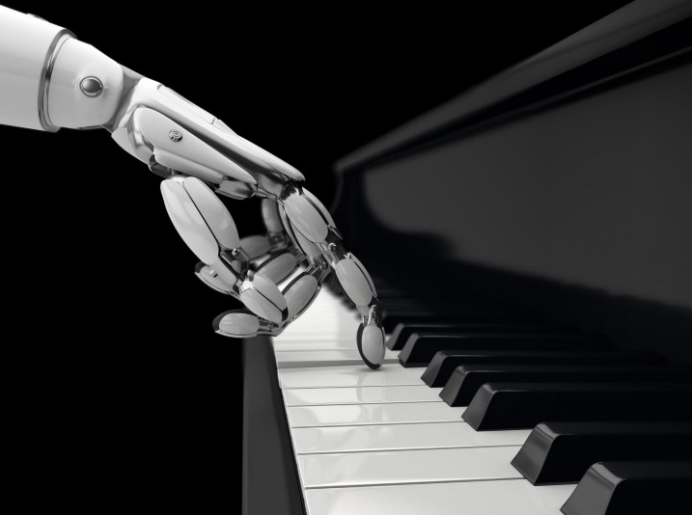
- Premiere — Ludger Brümmer: Non può sentir dolore, (verspürt nicht mehr den Schmerz), 2022
- Premiere — Orm Finnendahl: Ordonarequin/Traum der elektrischen Schafe, 2022
Komposition:
- Johann Sebastian Bach: Der Geist hilft unser Schwachheit auf BWV 226, Motette für zwei 4stimmige gemischte Chöre, 1729
- Iannis Xenakis: Morsima-Amorsima, 1962
- Iannis Xenakis: Serment-Orkos, 1981
- Karlheinz Stockhausen: Trauer mit Humor, 1987
- Josquin des Préz: Une mousse de Bisquaye
- Gottfried Michael Koenig: Funktion Indigo
- Antoine Brumel: Kyrie I -Christe -Kyrie II aus Missa Et ecce terrae motus
- SCHOLA HEIDELBERG | ensemble aisthesis
Moderation: Martina Seeber | Vortrag: Prof. Dr. Vincent Heuveline
Leitung: Walter Nußbaum & Ekkehard Windrich | Klangregie: Sebastian Schottke
Veranstalter: KlangForum Heidelberg e.V.
A scientific-musical dialog on spirit, thought, ethics, and esthetics as part of the anniversary year project "The Dignity - Whose?" by KlangForum Heidelberg e.V.
On multiple levels, KlangForum Heidelberg e.V. addresses in the current program of its ensembles, part of the year-round event series "The Dignity - Whose?", the encounter of spirit, dignity, and human image with methods and perspectives of technical, computational, and artificial intelligence. The award-winning vocal ensemble SCHOLA HEIDELBERG offers context and reference with works by Josquin des Prèz and Antoine Brumel from the Renaissance (as an era of the development of the modern concept of human dignity) for new, partly world-premiere works for voices, instruments, and live electronics by Orm Finnendahl (HfMDK Frankfurt), Ludger Brümmer (ZKM Karlsruhe), as well as for classical avant-garde works by Karlheinz Stockhausen and Iannis Xenakis, whose 100th birthday is to be celebrated this year.
Gottfried Michael Koenig, another grandmaster of the informatics and 'stochastic' influenced 20th-century avant-garde, will be remembered on the occasion of his death in December 2021 thru the performance of a multichannel electronic work (under the sound direction of his student and trustee Kees Tazelaar from the Instituut voor Sonologie in The Hague); this will be contrasted by an analog-instrumental work by Xenakis, which was already composed in 1962 with the help of an IBM computer.
Johann Sebastian Bach's motet "The Spirit Helps Our Weakness" also introduces a worldview-transcendental concept of the spirit and exposes the interplay of compositional, contrapuntal, and creative intelligence from another historical perspective.
"Artificial Intelligence and the Sigh of Culture? - Of Spirit and Transhumanism" thus addresses, thru mutual references and reflections, the comprehensive ability of the creative spirit, whether humanistically or technologically shaped, to culturally appropriate the world. The interdisciplinary exchange between science and art, technology and esthetics is the implicit foundation of all the compositions presented here and also the subject of the introduction by mathematician Vincent Heuveline from the Heidelberg Institute for Theoretical Studies (HITS) as well as a panel discussion with the composers of the world premieres.