Cases of water
ever changing ... to the depths below
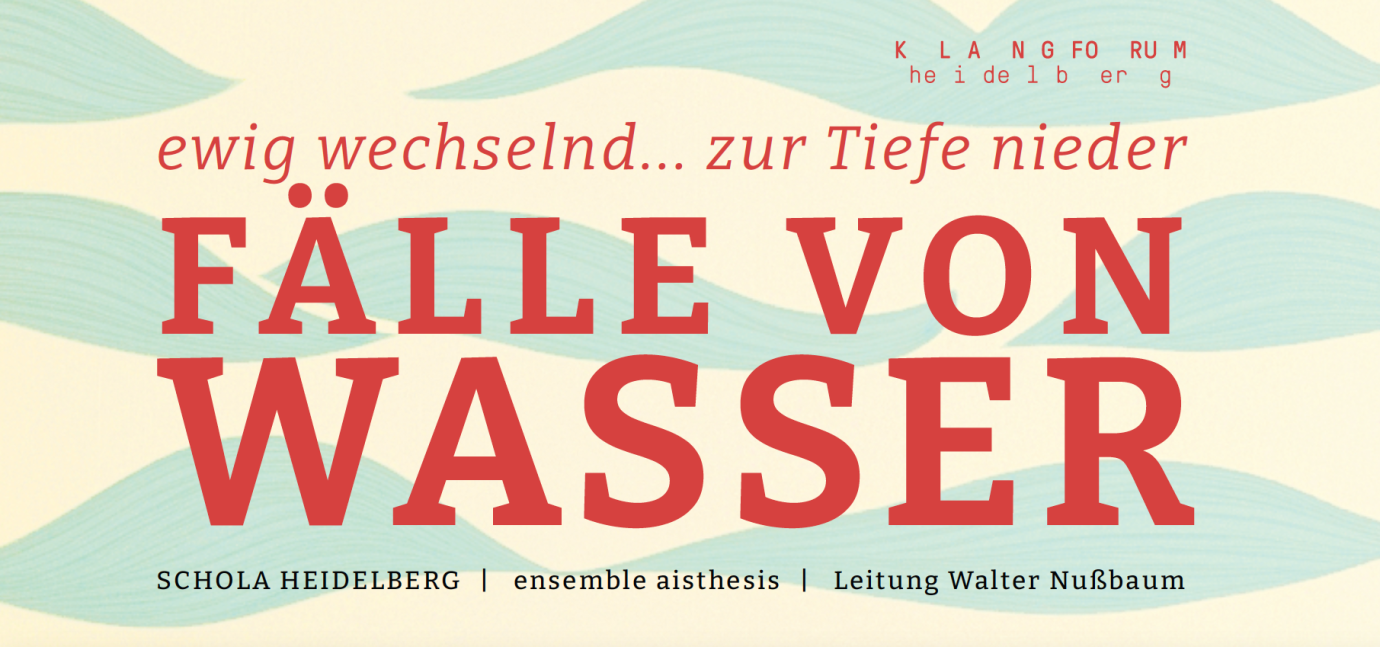
The project combines works of literature and music from different centuries on an aesthetic-philosophical, ecocritical, and artistic level to form a philosophical-transcultural discourse on cases involving water.
The combined works of Taiwanese-American composer Shih-Hui Chen (born 1962) and Austrian composer Franz Schubert (1797-1828) refer equally to literary sources:
Chen to poems by Li Bai (aka “Li Taibo”) 701-762, Su Shi (1037-1101) and Zhang Jiuling (673?-740) about a waterfall on the legendary Chinese cultural mountain Lushan, Schubert's “Gesang der Geister über den Wassern” (Song of the Spirits over the Waters) on Johann Wolfgang von Goethe's six-stanza poem of the same name from 1779, inspired by the Staubbach Falls in Lauterbrunnen, Switzerland.
The event considers different re-mediations of Goethe's poem in Schubert's work by including several earlier settings in various instrumentations (from a fragment of an art song for baritone and piano to quartets for male voices with and without accompaniment to the unusual final version [1] for four low string instruments and eight male voices, D 714, from 1821, which is unique in the concert repertoire in this instrumentation).
Shih-hui Chen's composition ultimately fits into this cycle:
I've done some research and have been considering writing my piece influenced by Schubert’s setting of Goethe’s text. The imagery and meaning in Goethe's text remind me of three Chinese poems inspired by the waterfall in Mount Lu. Like Goethe's muse, the Staubbach Falls, these poems convey a deep, spiritual connection to nature that transcends time and cultural boundaries. (Shih-Hui Chen, 05.11.2024)
On July 2, 2025, from 2:00 to 3:30 p.m., a digital dialogue will take place between composer CHEN Shih-hui, J. Marc Reichow (KlangForum Heidelberg), Rolf Scheuermann (Buddhology, Environmental Humanities), and Barbara Mittler (Worldmaking—A Dialogue with China: Epochal Lifeworlds, Narratives of Crisis and Change) will take place, reflecting on the different perspectives. To receive the link to the event, please register at: xiaojie.chang@zo.uni-heidelberg.de
[1] Composed from 1816, published posthumously; D484 as well as D538, D704, D705)