Music in Context: Peter Gülke and Nikolaus Brass
Betriebswerk Heidelberg
Komposition:
- Orlando di Lasso: Prophetiae Sibyllarum, ~ 1560
- Heinz Holliger: nicht Ichts - nicht Nichts, 10 Monodisticha von Angelus Silesius für vier Stimmen (SATB) a capella, 2010-2011
- Stefan Wolpe: Three canons for two voices with the accompaniment of a third voice, aus: Music for any instruments: Interval Studies, 1944-49
- Guillaume Dufay: Gaude virgo, mater Christi (Sequenz), In festo Assumptionis beatae Mariae Virginis
Veranstalter: KlangForum Heidelberg e.V.
Echoes with Sibyls (2019)
for four voices and four instruments
based on the Prophetiae Sibyllarum (~1560) by Orlando di Lasso
A commission by KlangForum Heidelberg
I once boldly claimed that it is only in relation to tradition that we contemporary composers find our measure. Thus, Echos mit Sibyllen is another attempt (following my engagement with Heinrich Schütz’s musical Exequies) to at least endure this measure, for it is relentless. As I approached Lasso’s four-part Prophetiae Sibyllarum in an attempt to grasp it, the courage of a greenhorn faded. Music, text, and proportions formed an impenetrable fortress of obstinacy. I saw no gap where I could take refuge.
So I followed the trail of my own deflections from Lasso’s phrasing and compositional artistry; I found myself cast back before the piece, not within it. The Carmina chromatica stand as a peculiar signpost at the entrance to the truly “chromatic” 12-part labyrinth of the Prophetiae. Thus my piece begins with a preamble before this signpost, whose text my old Lasso edition intimidatingly translates as: "Songs from foreign lands you shall hear in artful composition," and frames it with a second preamble. A creeping around, not yet a real approach. After the first of the Sibyls, the one from Persia, the "1st Echo" sets in: Ille Deus casta nascetur virgine magnus. This intense linguistic and generative intertwining of the mightiest (Ille Deus magnus, that great God) which emerges from "the weakest" (nascetur casta Virgo, will be born of the untouched Virgin) set music in motion that carries within it the inner tension of this intertwining and adds the unique world of natural spectral tones to the wondrous world of Lasso’s chromaticism. This "Echo" also spins the text line further: multi multa ferrent (which can be translated as: Many must endure much). Following the Libyan Sibyl’s prophetic speech, further "Echos" appear: one for soprano and alto (per saecula vivus, living across the ages), followed by a purely instrumental Echo (Princeps irradians, radiant, dazzling prince), which is followed by a fourth Echo (Lumine clarescet, bathed in radiant light). Following the voices of further Sibyls come "Echo 5" with the promising phrase: ecce dies nigras quae tollet laeta tenebras (behold the joyful day that lifts the black darkness) and "Echo 6," another purely instrumental verse based on the phrase: he will be given to the world as a poor man (edetur mundo pauper), until the piece then concludes with the "7th Echo": humano simul et divino semine natus (Born of human and at the same time divine seed).
The nature of the echo lies in its being indistinct, yet lingering. Questionable, yet when it is heard, it brings joy. One searches for the places where it speaks to us. Often, all that remains of the echo is its absence. It is the echo’s elusiveness that makes us seek it out again and again.
Nikolaus Brass (October 2019)
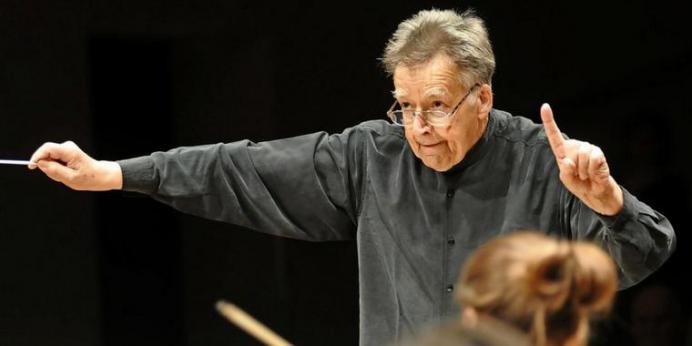
Guests: Peter Gülke (Weimar) | Nikolaus Brass (Lindau)
SCHOLA HEIDELBERG | ensemble aisthesis | Conductor: Walter Nußbaum